

Precious Metals Volatility: Understanding the Silver Sell-Off After Historic Rallies
Silver, long viewed as a defensive asset, briefly traded more like a momentum stock. After a year-long surge that pushed prices to historic highs, silver experienced a sudden collapse, falling roughly 30% in a single session, the sharpest decline since 1980.¹ The speed of the move raised an obvious question: how did a traditional store of value become so volatile, and what does the episode reveal about speculative behavior in today’s markets?
From Structural Story to Speculative Surge
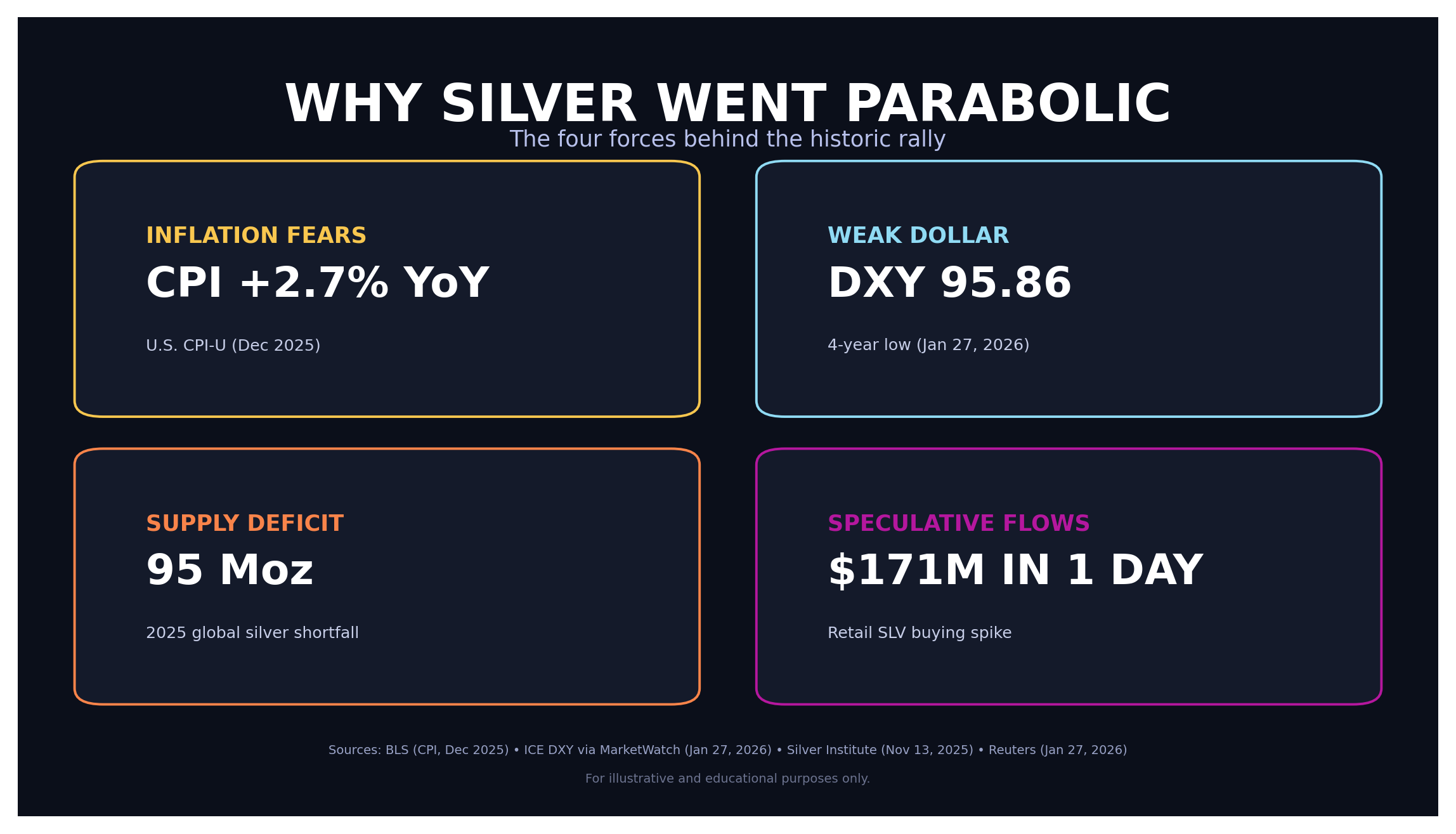
The sell-off followed an extraordinary rally. Over the prior year, silver prices more than tripled and briefly exceeded $100 per ounce for the first time.² The advance initially rested on credible fundamentals. Persistent inflation concerns, a weakening U.S. dollar, and years of supply deficits supported growing investor interest. Industrial demand also played a role, with silver usage in electronics and solar applications already near record levels.³
As prices climbed, speculative dynamics took over. Retail participation accelerated, online enthusiasm intensified, and silver increasingly traded as a macro hedge rather than an industrial input. By late 2025, price action reflected momentum and positioning more than supply-demand balance.⁴ The metal had effectively become a consensus trade.
The Catalyst That Reversed the Trade
The trigger arrived abruptly. A surprise announcement surrounding a hawkish Federal Reserve nomination shifted expectations for monetary policy, sending the U.S. dollar sharply higher.¹ That move undercut the core thesis behind the silver rally: currency debasement. With the dollar strengthening, traders rushed to unwind crowded positions. Profit-taking cascaded into forced selling as volatility spiked.
Market participants had long anticipated some form of correction. After such a parabolic run, sentiment was fragile. Once prices began to slide, liquidity evaporated and losses compounded. A year’s worth of gains disappeared within hours.¹
When Fundamentals Push Back
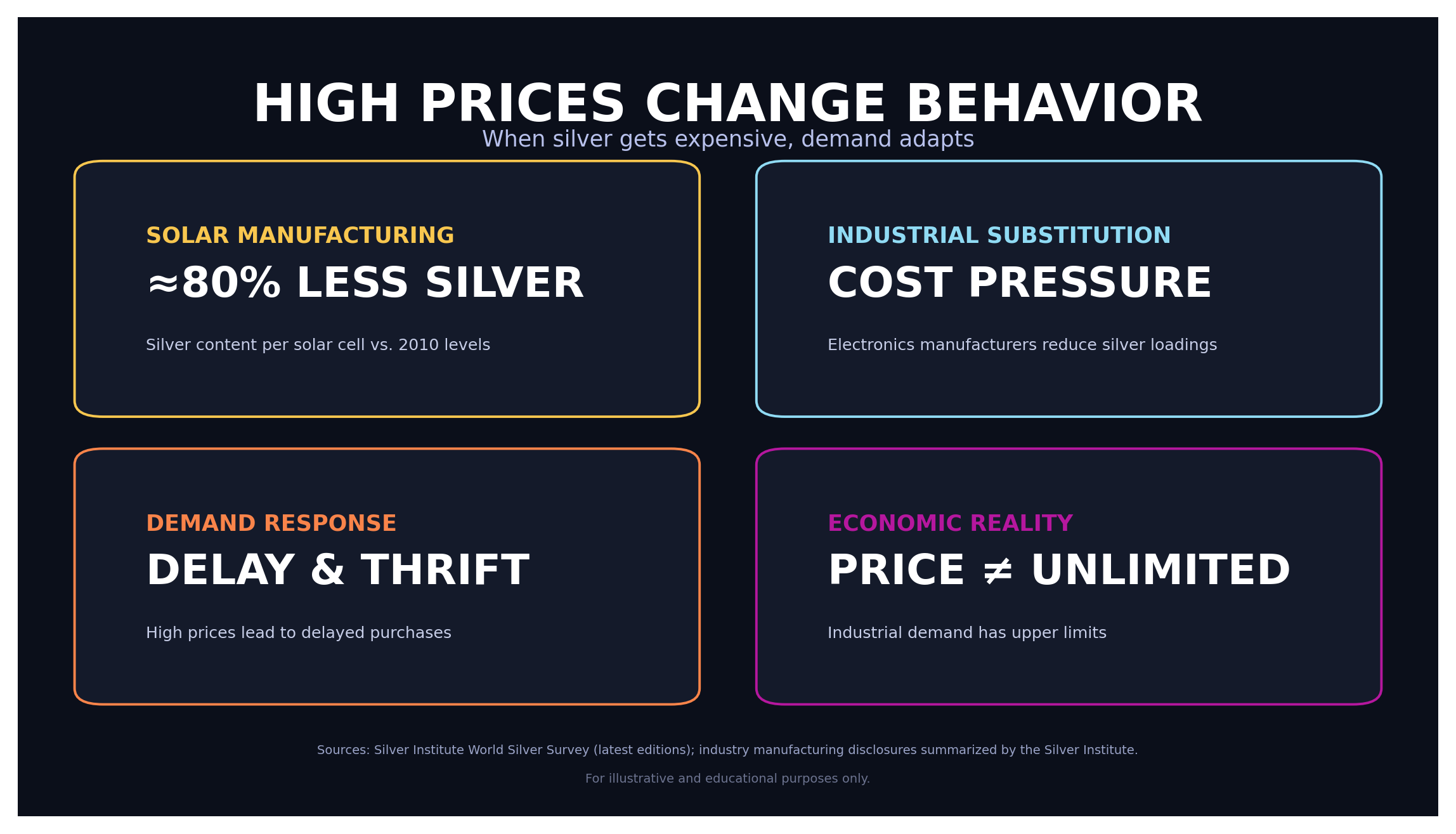
Despite the speculative excess, silver’s fundamentals were not imaginary. Global demand had exceeded supply for several consecutive years, and mine production remained constrained due to silver’s status as a byproduct of other metals.³ Yet prices ultimately moved beyond what end-users could absorb. Manufacturers responded predictably. High prices encouraged substitution, reduced usage, and delayed procurement.⁴
History reinforces the lesson. Similar episodes occurred in 1980 and again in 2011, when silver surged during periods of financial stress before suffering prolonged declines.² Silver’s dual identity explains these extremes. It behaves like a safe haven during periods of uncertainty, but it remains an industrial commodity with real economic limits.
Silver’s long-term role in clean energy and advanced manufacturing remains intact. What changed was the price. The recent sell-off underscores that even assets with compelling narratives are vulnerable when speculation overwhelms fundamentals. Financial gravity, eventually, reasserts itself.
Footnotes
Jennifer Sor, “Trump’s Fed Pick Has Sparked a Gold and Silver Meltdown,” Business Insider, January 30, 2026.
Will Ebiefung, “Silver Soared 144% in 2025. History Says It Could Crash in 2026,” The Motley Fool, January 27, 2026.
Silver Institute, “The Silver Market Is on Course for Fifth Successive Structural Market Deficit,” November 13, 2025.
Ole Hansen, “Gold’s Orderly Rally Meets Silver’s Chaos as the Dollar Comes Under Pressure,” Saxo Group, January 28, 2026.
This material presented by Dynamic Wealth Group (“DWG”) is for informational purposes only and is not intended to serve as a substitute for personalized investment advice or as a recommendation or solicitation of any particular security, strategy, or investment product. Facts presented have been obtained from sources believed to be reliable, however DWG cannot guarantee the accuracy or completeness of such information, and certain information presented here may have been condensed or summarized from its original source. DWG does not provide legal or tax advice, and nothing contained in these materials should be taken as legal or tax advice.