

Tech Pullback, Value Rotation: What the Recent Sell-Off in High-Beta Means for Thematic Investors
The October rally hit a wall in early November 2025 as high-flying technology and growth stocks slid sharply. Investors began questioning stretched valuations in areas such as artificial intelligence and cloud computing amid renewed uncertainty surrounding Federal Reserve policy and the U.S. government shutdown¹². The tech-heavy Nasdaq sank more than the broader market, while defensive sectors quietly advanced³. Real Estate, Financials, and Health Care were the only sectors in positive territory on the day of the sell-off³. Value stocks, meanwhile, absorbed less damage: growth-oriented funds dropped roughly three times as much as their value counterparts⁴. What had been a technology-driven updraft suddenly turned into a rotation toward balance sheets and dividends.
Thematic Portfolios Feel the Pressure
For investors chasing today’s big ideas—AI, clean energy, digital health, or robotics—the pullback was a jarring reminder that thematic exposure often carries concentrated risk. Thematic investing has exploded in popularity, with ETFs built around buzzwords such as “AI” and “clean energy”⁵. Many of these products lean heavily on high-beta or speculative names, leaving them vulnerable when market sentiment cools. Under stress, investors rediscover fundamentals. Capital has rotated toward companies with steady earnings, lower valuations, and consistent profitability⁶.
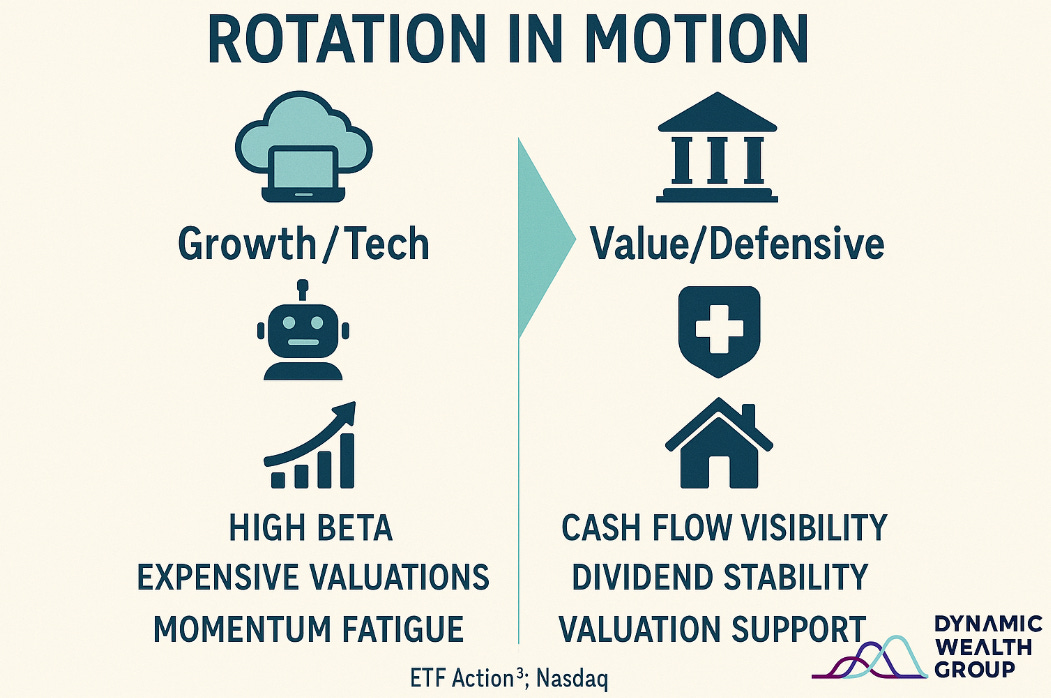
This environment is forcing a distinction between themes built on substance and those resting on narrative. Academic research has long shown that only a small share of thematic baskets exhibit durable performance or coherent risk factors⁵. Others function mainly as marketing stories, more volatile than diversified indexes. The latest sell-off rewarded “steady growth” exposures like utilities and consumer staples while punishing pure-play AI or biotech firms. The takeaway: every theme deserves scrutiny. Does it reflect a lasting demand trend—or an assumption that valuations will always rise?
Navigating the Rotation
By late 2025, most strategists view the correction as overdue rather than catastrophic. Pullbacks after extended rallies are healthy. Still, thematic investors should reassess concentration risk. That may mean trimming outsized tech winners or re-balancing portfolios toward undervalued sectors. Importantly, this is not an argument to abandon innovation altogether. Structural trends such as AI adoption and the energy transition retain long-term potential, provided investors approach them with valuation discipline.
Diversification remains the simplest hedge. Balancing high-growth exposure with quality value holdings—health-care innovators using AI, or renewable-energy firms with proven cash flows—can temper volatility. Due diligence also matters: many thematic ETFs simply repackage large-cap stocks under a fashionable label, offering little differentiation beyond higher fees.
The current rotation is less a rejection of technology than a re-pricing of risk. Fundamentals are regaining importance. Thematic investors who couple conviction with careful analysis stand to benefit most as markets recalibrate.
Footnotes
“Tech Titans Tumble: A Deep Dive into the November 2025 Market Sell-Off,” Chronicle Journal, Nov. 7, 2025.
“Tech Stocks Leading Extended Pullback on Wall Street,” Nasdaq, Nov. 2025.
“Markets Retreat on Tech Sell-Off; Defensive Sectors Lead,” ETF Action, Oct.–Nov. 2025.
Ibid.
“Thematic Investing: What Are the Real Risks?” Alpha Architect, 2024.
Chronicle Journal, Nov. 7, 2025.
This material presented by Dynamic Wealth Group (“DWG”) is for informational purposes only and is not intended to serve as a substitute for personalized investment advice or as a recommendation or solicitation of any particular security, strategy, or investment product. Facts presented have been obtained from sources believed to be reliable, however DWG cannot guarantee the accuracy or completeness of such information, and certain information presented here may have been condensed or summarized from its original source. DWG does not provide legal or tax advice, and nothing contained in these materials should be taken as legal or tax advice.