

The Case for Shorting Live Cattle

You don’t need a Bloomberg terminal to feel the cattle market. You feel it when you pause at the meat case and wonder when steak became a special occasion purchase.
USDA’s Economic Research Service reports beef and veal prices in December 2025 ran sharply above the prior year’s level, which helps explain why the live cattle narrative has turned into a one-way story for a lot of investors and commentators.¹
The short thesis is simple: live cattle prices can fall even if the herd stays tight. Futures don’t need abundant cattle to move lower; they need a catalyst that changes the balance of power between buyers and sellers.
Right now, the most plausible catalyst is demand that bends at the margin, paired with supply that quietly loosens through heavier weights and more imports.
Tight Supply Explains the Rally, Not the Next Move
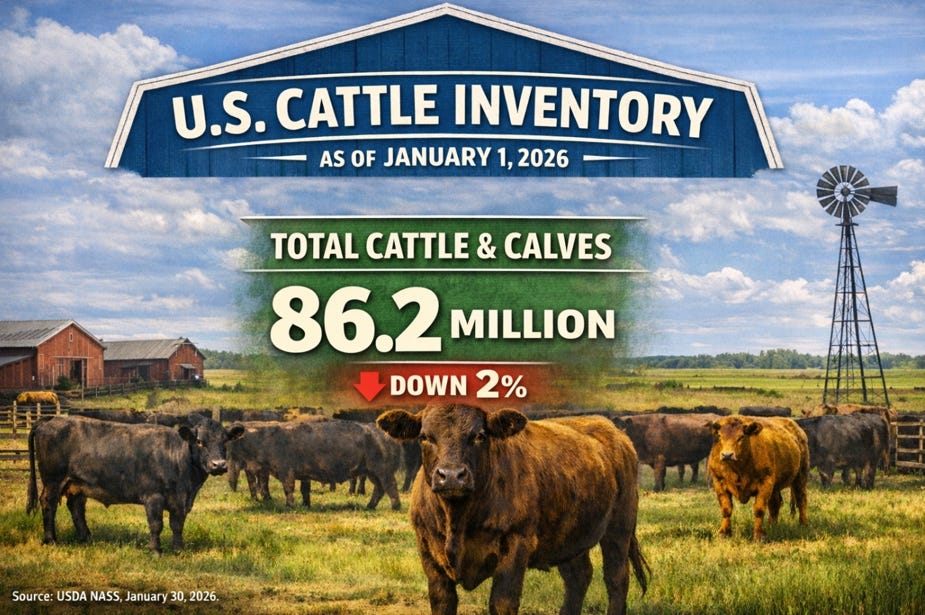
USDA’s January 2026 Cattle Inventory report put total U.S. cattle and calves at 86.2 million head as of January 1, 2026, with beef cows down from a year earlier and the calf crop also lower.² Those figures capture the physical reality behind high prices: rebuilding a herd takes time, and the cattle cycle tends to play out over many years because biology moves slower than markets.³
That same slow clock can lure investors into a trap. When everyone agrees supply is limited, prices start to reflect perfection. At that point, the market becomes less sensitive to “still tight” and more sensitive to “not as tight as feared.”
A small change in expectations can do the work that a big change in the herd cannot.
Demand Is the Weak Link, and Packers Tell You First
High beef prices don’t just squeeze consumers. They squeeze the entire chain, from grocers to restaurants to processors. Tyson has flagged how tight cattle supplies pressure its beef business while pointing to chicken as a relative beneficiary when shoppers shift proteins.⁴
That’s the demand story in plain English: consumers trade down, menus adjust, and beef loses a bit of negotiating leverage.
Supply can also loosen without a herd expansion headline. USDA’s Livestock, Dairy, and Poultry Outlook has highlighted dynamics like heavier carcass weights and a higher beef import forecast, both of which can add tonnage into the system even when the cow count stays constrained.⁵ USDA’s boxed beef cutout framework matters here because it reflects the value packers can realize from the beef they sell. When that value softens, packers resist paying up for live cattle.⁶
The monthly Cattle on Feed report offers another reality check.
The February 2026 release showed fewer cattle on feed versus the prior year, alongside lower placements and sharply lower marketings.⁷
Marketings fall when packers run fewer cattle through plants. That choice can signal margin pressure and weaker near-term appetite for buying fed cattle, which can ripple into futures pricing.
What Could Go Wrong?
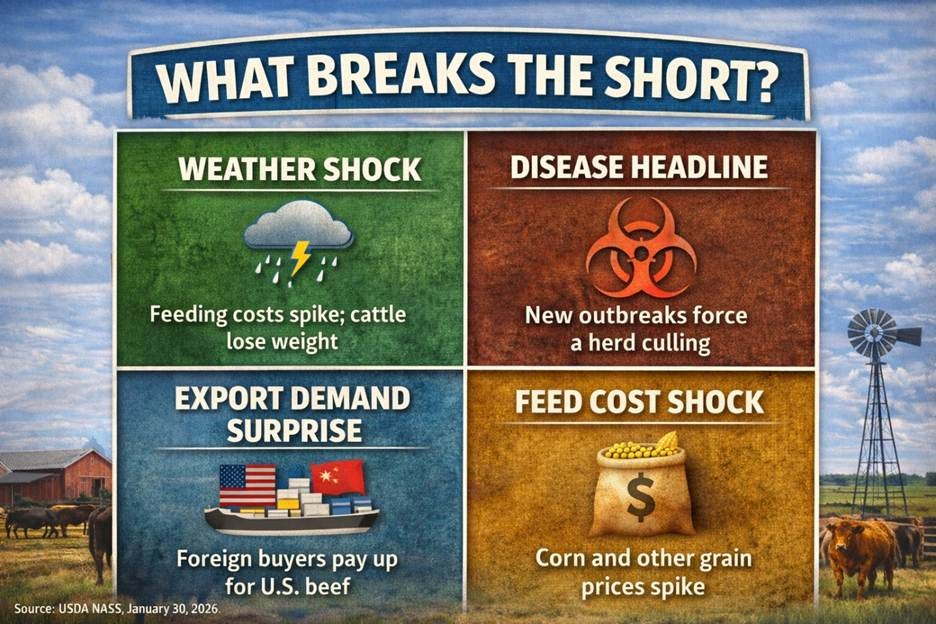
Shorting any commodity can feel like standing in front of a moving train. Live cattle can spike on weather shocks, disease headlines, export surprises, or a sudden jump in retail demand.
The way to think about this trade is not that beef is expensive, therefore cattle must fall, but rather, live cattle looks priced for a world where demand never blinks, and packers keep bidding no matter what.
Markets rarely reward that kind of certainty for long.
This material presented by Dynamic Wealth Group (”DWG”) is for informational purposes only and is not intended to serve as a substitute for personalized investment advice or as a recommendation or solicitation of any particular security, strategy, or investment product. Facts presented have been obtained from sources believed to be reliable, however DWG cannot guarantee the accuracy or completeness of such information, and certain information presented here may have been condensed or summarized from its original source. DWG does not provide legal or tax advice, and nothing contained in these materials should be taken as legal or tax advice.
Footnotes
1. U.S. Department of Agriculture, Economic Research Service, “Food Price Outlook: Summary Findings,” January 23, 2026.
2. U.S. Department of Agriculture, National Agricultural Statistics Service, “Cattle,” released January 30, 2026.
3. U.S. Department of Agriculture, Economic Research Service, “Cattle and Beef: Sector at a Glance,” May 22, 2025.
4. Tyson Foods, “Fourth Quarter 2025 Earnings Conference Call Transcript,” November 10, 2025.
5. U.S. Department of Agriculture, Economic Research Service, “Livestock, Dairy, and Poultry Outlook: February 2026” February 17, 2026.
6. U.S. Department of Agriculture, Agricultural Marketing Service, “User’s Guide to USDA’s Boxed Beef Cutouts,” January 2026.
7. U.S. Department of Agriculture, National Agricultural Statistics Service, “Cattle on Feed,” February 20, 2026.